Technical Report · 2026
Dream-RSI: Recursive Self-Improvement
through Evolving Worlds
1Google · 2University of Maryland, College Park · 3Google DeepMind · 4University of Virginia
✉Corresponding authors
An agent must dream to recursively self-improve. History is the world it dreams in.
Meta-level feedback is the bottleneck
Recursive self-improvement runs on a discovery loop, and at the scale that now matters that loop spans thousands of proposal–evaluation cycles. What decides whether those cycles are worth their compute is exploration — where to branch, what to run in parallel, when to cut a line off — and exploration is the one component still hand-written and frozen. That leaves a dilemma with no good side. A fixed strategy cannot learn from the experience it accumulates, so it keeps paying for directions that have already failed. Optimizing it online walks into two walls at once: meta-level feedback is delayed and expensive, because judging an exploration policy means watching it steer an entire discovery run to the end rather than scoring one candidate; and the meta-policy space is vast, so most of the policies you would have to try are bad ones — each costing a full rollout to find that out.
The idea
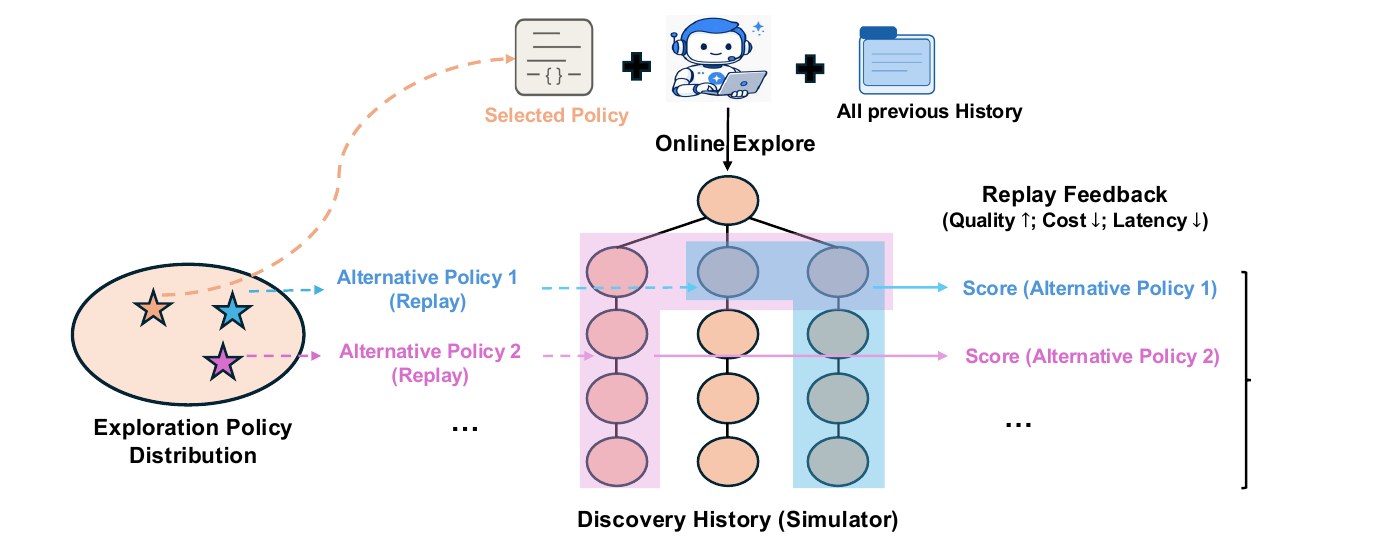
You have already paid for that feedback. A finished discovery run is not just text to re-read — it is a structured tree of every exploration decision the agent made, each one carrying the execution outcome it actually produced. And an exploration policy does exactly one thing: given what it has seen, choose which attempt to continue next. So an alternative policy never has to re-run anything. It walks the same recorded tree in a different order, and every outcome it asks for is already on disk. Screen thousands of candidates against what already happened at zero executions, and spend a real rollout only on the winner.
-
01
Off-policy, not online
Policies are screened offline against the simulator pool, so a bad meta-proposal costs replay time instead of a full online rollout.
-
02
The agent stays untouched
A thin orchestration layer makes exploration explicit and programmable while leaving the underlying coding agent exactly as it is.
-
03
It cannot regress
The policy already deployed is itself one of the candidates being replayed, so the one that ships is never worse than the one it replaces.
History is already a simulator
A simulator is anything that can answer “what would have happened if…” without running the world. For exploration policies that object already exists, fully built and fully paid for, and nobody was using it.
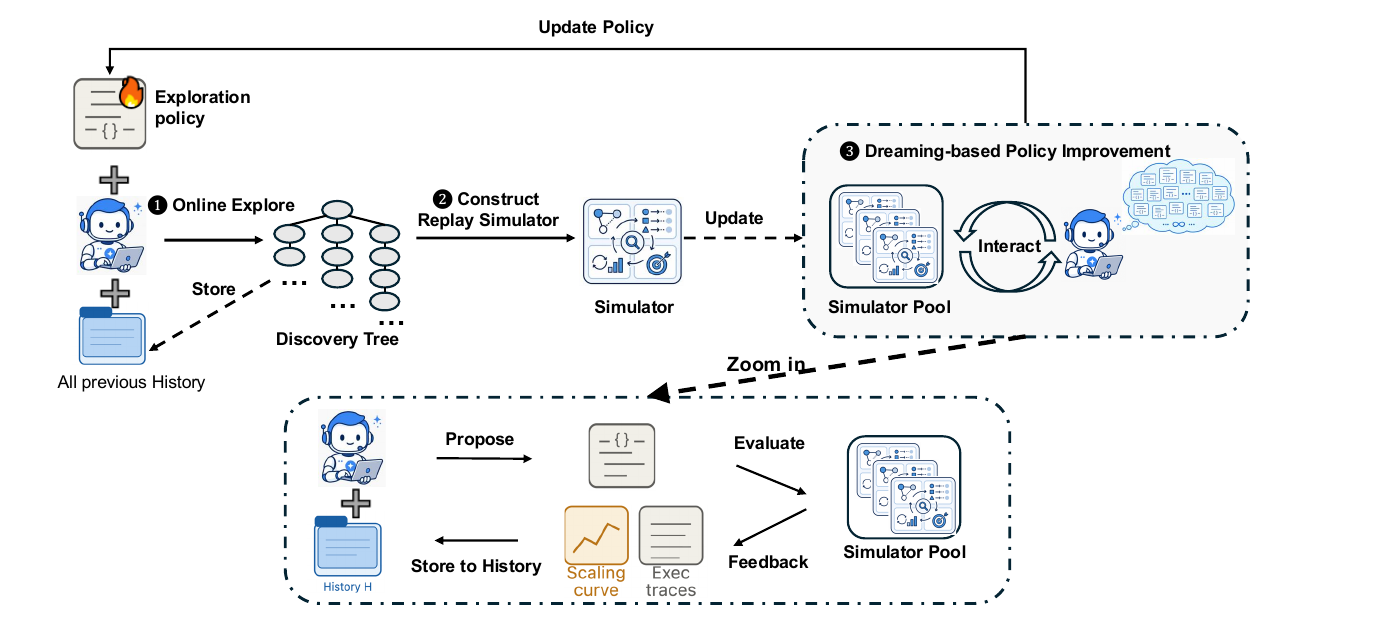
Think of an agent crossing unfamiliar terrain for the first time. It takes inefficient routes, hits dead ends, backtracks — and in doing so it draws a map. The next policy does not have to walk the ground again. It reasons over the map: it avoids the known dead ends, reconsiders decisions the first policy committed to too early, and compares whole routes before moving. Long-horizon discovery has exactly this structure, and the map is already being written. A completed run records a tree of exploration decisions together with their realized code-execution outcomes, so replaying a different policy over it means traversing different branches, in a different order, with different parallel groupings and different stopping points — over nodes that have all already been run. The evaluation returns immediately and costs zero executions.
That history has been sitting there all along; prior work just read it as something else — static textual context to prompt against, or training data to fine-tune weights on. Read as a tree, it is a simulator, and unlike a learned world model it is not an approximation. Nothing is predicted: the simulator is exact over the search space that was realized, because it is that search space. Its limit is just as sharp — a policy can only be dreamt where history actually went. Which is what forces this to be a loop rather than a one-off. Every online deployment widens the simulator, a wider simulator supports a better next policy, and that policy widens it again: the worlds the agent dreams in evolve along with it.
Dream-RSI is what falls out of that. A lightweight orchestration layer makes exploration explicit and programmable while leaving the underlying coding agent unchanged. Dreaming inside the replay simulator built from historical discovery trees buys immediate, low-cost off-policy feedback for evaluating and refining exploration policies, without repeating expensive online evaluations. The improved policy is redeployed to drive further discovery, continuously expanding the simulator pool. Across algorithm engineering, mathematical optimization and GPU kernel engineering, this reaches competitive or better discovery quality at substantially lower discovery cost.
Recursive self-improvement on the meta-exploration layer
Let $t = 1, 2, \dots$ index the outer iterations. Starting from an initial policy $\pi_1$ and an empty history $\mathcal{H}_0 = ()$, iteration $t$ deploys $\pi_t$ online to guide the discovery agent, collecting a discovery trace $\mathcal{T}_t$ with tree structure. The completed tree is appended to the history:
The exploration policy is executable code: it decides where a fixed discovery agent continues searching, which attempts run in parallel, and when exploration stops. A fixed evaluator scores the resulting candidates and returns diagnostic feedback.
Why the policy can never get worse
The offline phase is a policy-development agent writing $M$ successive revisions of the policy’s code, $\pi^0 = \pi_t, \pi^1, \dots, \pi^{M-1}$, and scoring each by replay over the whole history. Since the currently deployed policy $\pi^0$ is itself a candidate, the winner $\pi_{t+1} = \pi^{m^*}$ is never worse than $\pi_t$.
Watch a policy dream itself better
One lap of the loop in Figure 1. The agent explores online, appends the discovery tree to its history, rewrites its exploration policy a few times and scores every version by replaying it over that history — then redeploys the best one. Drawn live, not recorded.
Growing the tree costs real agent calls; replaying it costs none, because every node’s outcome is already recorded — so one expensive online rollout pays for thousands of off‑policy evaluations. Each replayed version opens several branches at once and drops each one when it stops paying, so what it covers is a subtree of the recorded tree, and it is charged for every node in it. The inner loop is a policy‑development agent rewriting the exploration policy: π0 is the version already deployed and π1…π3 are its revisions, each scored by replay over the whole history ℌt. Because π0 is in the candidate set, the version that ships can never score worse than the one it replaces — which is why the bars only go up. In the paper this cuts discovery-agent calls by 1.7× against fixed exploration and up to 162× against SimpleTES. Numbers on the canvas are illustrative; the real ones are in Results.
Three discovery domains
Eight discovery tasks across algorithm engineering, mathematical optimization and GPU kernel engineering. The controlled baseline is Recursive Fixed Exploration — identical agent, evaluator, initialization and per-round budget, but the exploration policy never changes. Both methods start from the same hand-written parallel-refine policy, so round 1 is identical by construction.
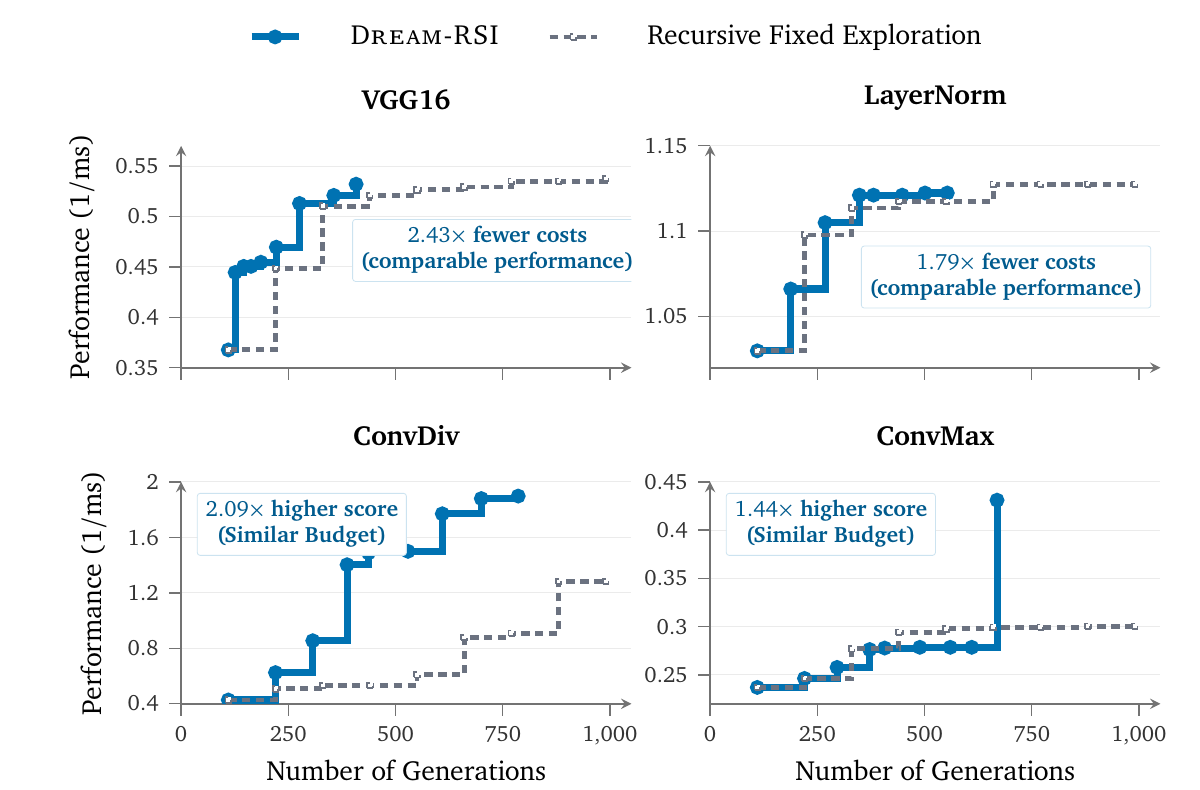
- 2.43×fewer generations on VGG16 at comparable performance
- 2.09×higher score on ConvDiv at a comparable budget
- 162×fewer discovery-agent calls than SimpleTES on Lasso
Algorithm engineering — Lasso regularization path
| Method | Model | Compute | Gisette | RCV1 | DNA | Leukemia | Colon | Duke Breast | Avg. |
|---|---|---|---|---|---|---|---|---|---|
| Previous solvers | |||||||||
| sklearn | – | – | 11275.2 | 252881.7 | 93.8 | 227.2 | 229.8 | 374.0 | 44180.3 |
| glmnet | – | – | 9063.6 | 73072.8 | 351.9 | 45.0 | 24.2 | 47.7 | 13767.5 |
| SimpleTES | gpt-oss-120b | 51,200 | 3141.9 | 19625.6 | 15.9 | 15.5 | 11.6 | 18.1 | 3804.8 |
| SimpleTES† | gpt-oss-120b | 51,200 | 8651.0 | 41143.1 | 37.6 | 28.2 | 19.5 | 31.1 | 8318.4 |
| Our system | |||||||||
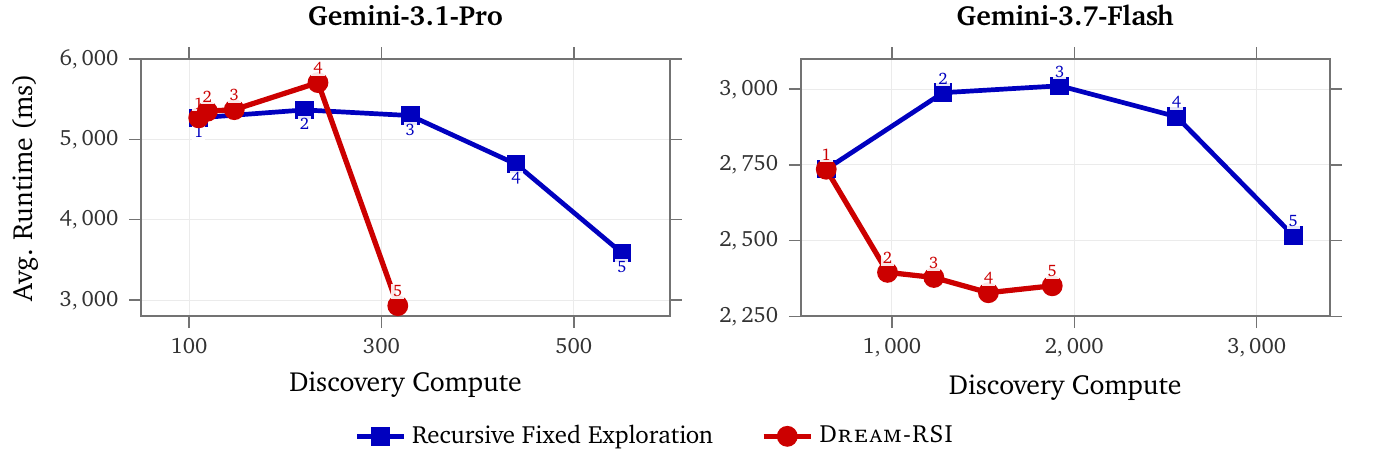
| Recursive Fixed Exploration | Gemini-3.1-Pro | 550 | 1861.8 | 19550.1 | 41.5 | 26.1 | 14.5 | 28.4 | 3587.1 |
| Recursive Fixed Exploration | Gemini-3.7-Flash | 3200 | 1133.1 | 13873.0 | 29.8 | 24.1 | 15.7 | 24.4 | 2516.7 |
| Dream-RSI | Gemini-3.1-Pro | 317 | 2841.0 | 14616.0 | 49.9 | 30.2 | 16.4 | 32.5 | 2931.0 |
| Dream-RSI | Gemini-3.7-Flash | 1879 | 1091.9 | 12923.4 | 31.4 | 21.0 | 12.2 | 23.6 | 2350.6 |
Final wall-clock runtime (ms) on six held-out downstream datasets; lower is better. Compute is the cumulative number of discovery-agent calls. † denotes our reproduction.
Mathematical optimization
| Method | LLM | Sum Diff ↑ | Auto Correlation ↓ | Circle Packing ↑ |
|---|---|---|---|---|
| AlphaEvolve | Gemini-2.0 Pro + Flash | – | 1.455700 | 2.635862 |
| AlphaEvolveV2 | Gemini-2.0 Pro + Flash | 1.121936 | – | 2.635983 |
| OpenEvolve | – | – | 1.460000 | – |
| CodeEvolve | – | – | – | 2.635980 |
| ShinkaEvolve | Mixed | – | 1.457800 | 2.635982 |
| TTS-Discovery | Qwen3-8B | – | – | 2.635983 |
| ThetaEvolve | Distilled-Qwen3-8B | – | 1.493000 | 2.635983 |
| EvoX | Gemini-3.0-Pro | – | 1.458900 | 2.635900 |
| SimpleTES | GPT-OSS-120B | 1.143975 | 1.453675 | 2.635983 |
| Our system | ||||
| Recursive Fixed Exploration | Gemini-3.1-Pro | 1.144047 | 1.456001 | 2.635983 |
| Dream-RSI | Gemini-3.1-Pro | 1.145427 | 1.456375 | 2.635983 |
Higher is better for Sum Diff and Circle Packing; lower is better for Auto Correlation. Best per column in bold.
SimpleTES holds the best Auto Correlation number, but needs 51,200 generations — against fewer than 1,000 here.
GPU kernel engineering
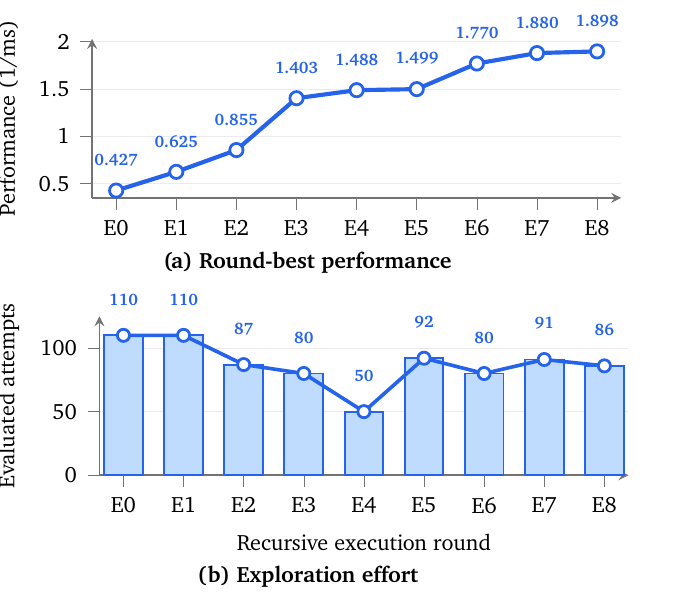
What the learned policy actually does
The policy is not monotonically greedier or broader — it is adaptive. As performance improves it first conserves compute, cutting evaluated attempts from 110 to 50. When progress plateaus it spends again, and those widenings line up with the next jumps in round-best score.
Semantic guidance is worse than replay
A natural alternative is to abstract prior trajectories into high-level directional insights and inject them into the prompt. Applied to both paradigms, this explicit guidance consistently underperforms its unguided counterpart under equal budgets. In long-horizon discovery with many parallel threads, strong semantic priors about where to search over-constrain the space and suppress diverse exploration.
BibTeX
@article{zheng2026dreamrsi,
  title   = {Dream-RSI: Recursive Self-Improvement through Evolving Worlds},
  author  = {Zheng, Tong and Wu, Xidong and Zhang, Zheng and He, Zhankui and
             Zhang, Chaoyi and Coleman, Benjamin and Wei, Ruoqiao and Bai, Di and
             Liu, Haolin and Liu, Rui and Wang, Xue and Zhuan, Yue and
             Kang, Wang-Cheng and Xiang, Renkai and Huang, Heng and
             Cheng, Xinwu and Guo, Yunsong},
  journal = {arXiv preprint arXiv:XXXX.XXXXX},
  year    = {2026}
}